



Warsaw Major Recap
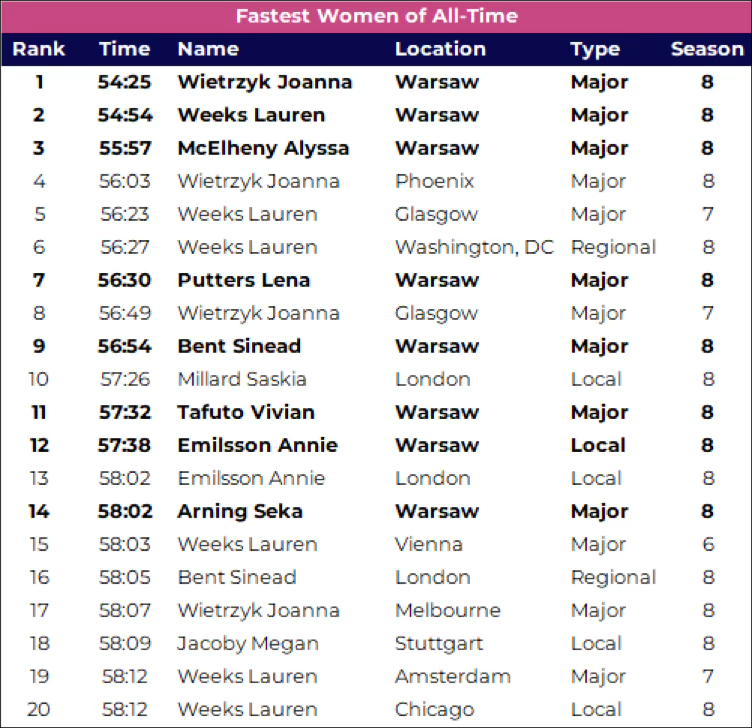
In case you missed it, Joanna Wietrzyk shattered the women’s HYROX world record at the final Major of the season in Warsaw. In one race, the women’s world record dropped from 56:03 to 54:25, a 2.9% improvement. Joanna and Lauren Weeks both skipped the 55-minute barrier entirely, while newcomer Alyssa McElheny also broke the previous world record with a 55:57 showing in only her 4th career race. Once the dust settled, 7 of the 14 fastest women’s times ever run were set over a 15-hour period in Warsaw, including by 2 women who ran the normal Pro race instead of the Elite 15 race:
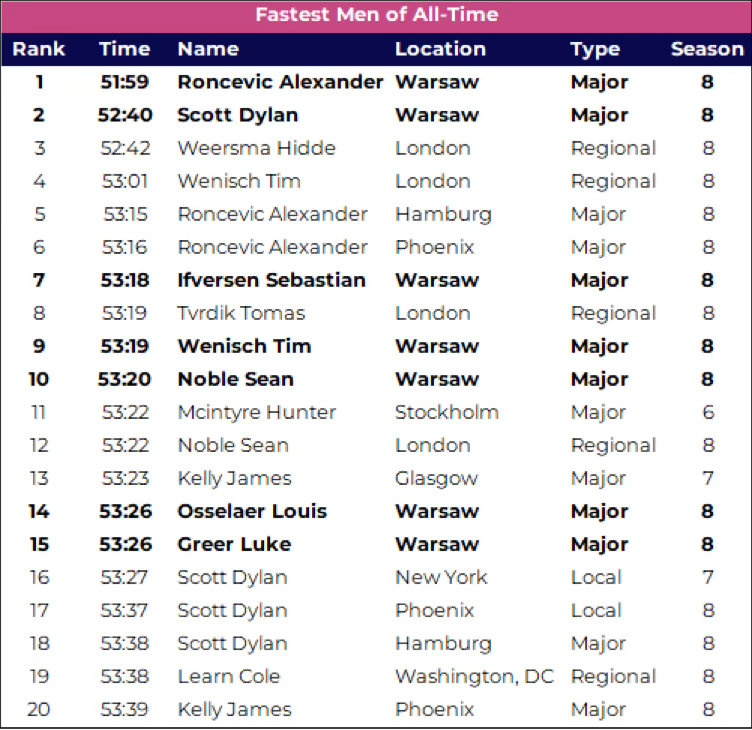
The men’s race was no different, with Alexander Rončević becoming the first man to run under 52 minutes. Hidde Weersma became the first man to ever run under 53 minutes just 4 weeks earlier in London (52:42), but Rončević improved his old best time (and previous world record) by 75 seconds in Warsaw. Similar to the women’s race, 7 of the 15 fastest men’s times ever run were set in the Elite 15 race in Warsaw:
Nearly Everyone Set a New PR
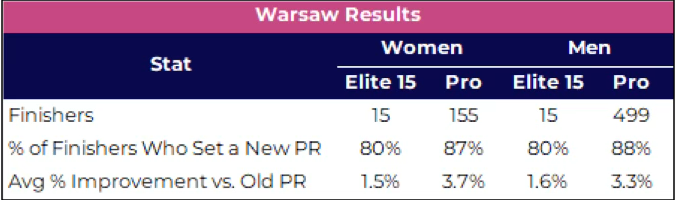
In both Elite 15 races, 12 of the 15 athletes crossed the finish line with a new lifetime PR. Sure, the competition was deep and conditions were favorable for fast running. The commentators were wearing jackets and noted that the temperature was 11.5o C (53o F), which is the perfect running temperature. Only 15 athletes were on the course at a time, and the grid layout was nice and compact. However, that doesn’t explain why so many athletes the next day were able to set lifetime PRs.
Fast times weren’t limited to the Elite 15 race, as 87% of Pro women and 88% of Pro men set a new lifetime PR in Warsaw. This was not a typical course. Many of these athletes have completed 10+ HYROX races, so it’s not like they’re all experiencing beginner’s gains. It’s virtually impossible for nearly 9-out-of-10 athletes set a PR in the same race, especially when they’re presumably not peaking yet since it’s still 2 months away from HYROX World Championship.
Warsaw vs. Other Results for Top-50 Athletes
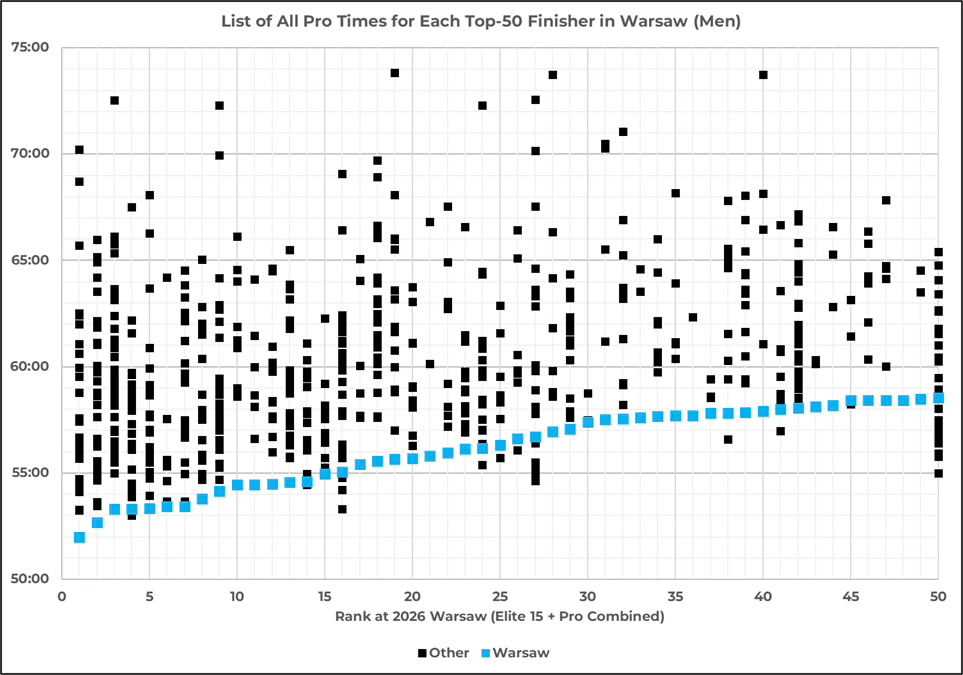
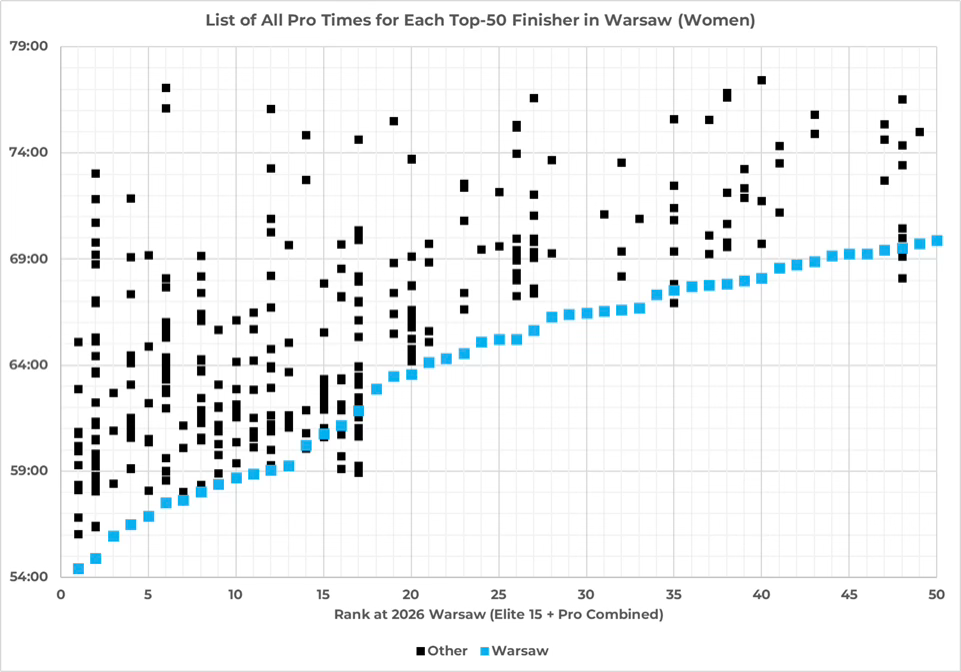
I looked at all lifetime results for the top-50 fastest men and women from Warsaw (Elite 15 and Pro times combined):
- Each vertical line is for the same athlete
- Blue = that athlete’s time from Warsaw
- Black = every other Pro HYROX time that athlete has run
- If a blue dot is at the bottom, that means they set a PR in Warsaw
There are 38 blue dots at the bottom of the top-50 men’s columns. You’re telling me that the course was normal yet 38 of the top-50 men happened to set PRs at the same race? Of the 12 men in the top-50 who didn’t set a new PR in Warsaw, 9 ran their 2nd-fastest time ever (average of just 33 seconds slower than their PR).
It’s even worse in the women’s race, as 43 of the top-50 finishers set a new PR. Of the 7 women in the top-50 who didn’t set a new PR in Warsaw:
- 4 ran their 2nd-fastest time ever
- 1 ran her 3rd-fastest time ever
- 1 ran her 4th-fastest time ever
- 1 ran her 7th-fastest time ever
World Record or Course Record?
Fortunately, HYROX is no longer using times to determine who qualifies for Elite 15 races, so these fast times from Warsaw won’t keep other athletes out of future Majors. However, the title of being the world record holder is a big deal. Should there even be a world record in HYROX, though?
Course layouts are never the same. Depending on the venue, you might run any iteration of 2-4 laps, have varying Rox Zone lengths, have varying indoor/outdoor weather conditions, etc. Elite 15 athletes also benefit from running on an open course with only 15 athletes and a compact grid layout, while Pro athletes usually have to wander through traffic all race with slower runners mistakenly using the “fast lane.”
Let’s use track-and-field as an example. Virtually every outdoor track is an identical 400m oval with 6-9 lanes. Could you imagine a venue creating a perfect track that is completely straight for 400m and built in the direction of a nice tailwind? Any world record set on that would never be ratified because the course layout isn’t standardized. Marathons also recognize that no two course layouts and elevation profiles are identical despite being the same distance, so they typically list course records in the results to compare this year’s results vs. results from previous years. Most people recognize that Eliud Kipchoge’s 1:59:40 isn’t the real marathon world record because the conditions during that race were so atypical.
Until HYROX creates a consistent, repeatable layout for all races (Elite 15 or Pro), comparing times isn’t accurate. How can you confidently say Alex’s or Joanna’s performances in Warsaw were better or worse than their previous fast times in Phoenix? You can’t because the course layout and conditions were different. That’s why we should use the term “course record” from now on instead of “world record.” Once HYROX has the same layout at all venues, then we can start talking about “world records” again.
Look, I don’t have any problem with Alexander Rončević or Joanna Wietrzyk having the fastest officlal times in HYROX history. Their resumes are among the best in the history of the sport. However, I think it’s time for HYROX to get rid of the term “world record.”
👉 HYROX APAC Preview 2026
Predictions, dark horses, and who’s about to shock everyone
▶️ https://youtu.be/m0NdH9dPYrk?si=EFnfnFIbWcZJz_nn
👉 HYROX Top 5 Moments You Can’t Miss
Chaos, clutch performances, and “did that just happen?” moments
▶️ https://youtu.be/AxXvvI7FF2k?si=Gh5saZ5k5prrpA48
👉 HYROX EMEA Recap 2026
Europe showed up… and made it everyone else’s problem
▶️ https://youtu.be/EKzjMjljT8Y?si=zQCg__rKzodHWb1b


Discussion